Inverclyde Companies
Ardgowan Distillery and the Return of Single Malt
Ardgowan is building a malt whisky future on Inverclyde farmland: the plan, the stills, the visitor offer and what a distillery means for suppliers.
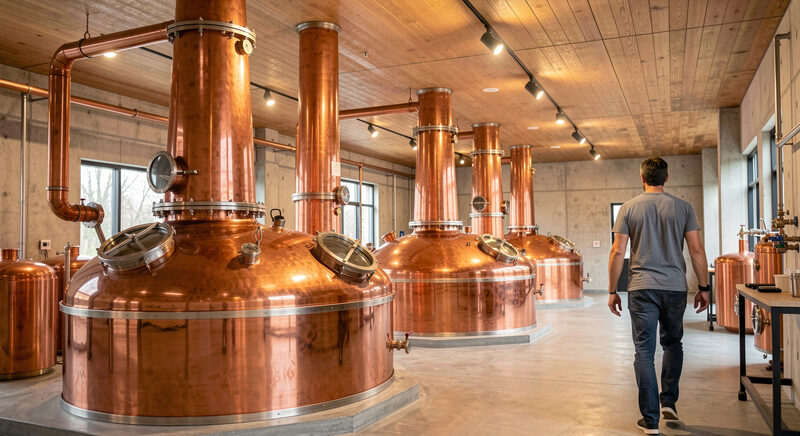
Whisky has come back to Inverclyde. On farmland above the Clyde a short drive from Greenock, the Ardgowan Distillery project has raised a modern malt house on an estate with a long history, and the first bottles from the venture have already found buyers. For a town that once shipped whisky, sugar and steel to the world, the return of distilling is both a business story and a statement about what the local economy can grow again. This page profiles the project and reads its local weight.
Farmland above the Clyde returns to distilling
The Ardgowan estate slopes towards the firth west of Greenock, and the distillery built there puts Inverclyde back on the whisky map after a long absence. The project was drawn up by a team with backgrounds in the drinks industry and backed by investors who saw what the location offers: proximity to Glasgow, land for maturation warehouses, deep water within reach for export, and a visitor catchment that includes every cruise passenger who steps ashore at the terminal described in Greenock Cruise Terminal and the Visitor Economy. Whisky is an industry that rewards patience with compound interest, and the plans were drawn on that timescale.
What the plans add up to
The distillery was designed around a conventional single malt toolkit: a malt mill, a mash tun, wooden washbacks and copper pot stills, with capacity intended to serve both the bottled brand and the trade in spirit for blending. Around the production core sit maturation warehouses, because the economics of malt whisky live in the warehouse: spirit laid down in a launch year earns its margin a decade later. The build phased equipment and employment so that the site could begin trading before the first malt matures, with jobs in production, warehousing, visitors and administration. The company publishes its current releases and visitor arrangements at ardgowandistillery.com.
The first bottles and what they sold
Before its own spirit was old enough, the company sold sourced and blended releases under its brand, a standard bridge used by new distilleries to keep the name alive during maturation. The business news that this domain carried while the local chamber published here recorded a milestone of exactly that kind: the first Discovery Edition sold out in less than a week, a result the trade read as evidence of demand for an Inverclyde whisky story. Sold out releases do not prove a distillery, but they do prove an audience, and audiences are what visitor businesses are built on.
Jobs, barley and the local supply chain
A distillery of this scale is a modest employer by the standards of the shipyards that once worked this waterfront, a comparison drawn in Shipbuilding on the Clyde: the Greenock Years, but its supply chain spreads wider than its payroll. Grain and malt contracts reach into Scottish agriculture, casks come from cooperages, engineering and construction firms win build and maintenance work, hauliers move spirit and glass, and packaging, labelling and design work lands with Scottish suppliers. Each permanent production job carries a tail of indirect work behind it, which is why development agencies treat distilleries as anchor investments for rural and waterfront economies rather than as single factories.
The visitor offer
The visitor side of the plan matters as much as the stills. Distillery tourism is one of the strongest performers in Scottish travel, and a well run tour converts brand interest into margin at the till. Ardgowan's location puts it within a coach run of the cruise quay, and tour operators building shore excursions around whisky have a reason to stop in Inverclyde that did not exist before. The tour trade connects directly to the passenger flows described in Greenock Cruise Terminal and the Visitor Economy and to the wider effort to lift town centre footfall traced in Greenock High Street After the Retail Slump.
What whisky means for the Inverclyde economy
The economic significance of the project is not the volume alone; it is the diversification. Inverclyde has spent decades rebuilding an economy that once rested on sugar refining and shipbuilding, an arc told in From Sugaropolis to the Cruise Age. A distillery adds a premium manufacturing sector with export reach, a year round visitor attraction, and a brand that mentions the area on bottles and back bars around the world. Export businesses from the area, such as the paper traders this domain's news used to follow, showed the same principle: places that ship branded goods keep a kind of income that retail alone cannot provide.
The long game of maturation
The honest reading of any young distillery is that judgement arrives in ten years, when the first fully mature spirit bottled under the site's own name reaches the market. Until then the signs to watch are employment at the site, the pace of warehouse filling, the sell through of interim releases and the growth of the visitor trade. The Greenock Ledger will follow those signs from the company desk indexed at Inverclyde Companies, alongside the other firms that employ the area's workforce, trained through routes described in Skills and the Young Workforce.